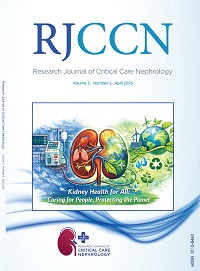
Kidney Health for All: Caring for People, Protecting the Planet
DOI:
https://doi.org/10.66224/rjccn.2.02.44Keywords:
environment, green nephrology, prevention, screening, sustainable kidney care, World Kidney DayAbstract
The current kidney care model—focused on late-stage disease
and in-center hemodialysis—is unsustainable, because of costs,
environmental burden, poor outcomes, and reduced quality of
life. The 78th World Health Assembly’s recognition of kidney
disease as a serious health threat presents a critical opportunity
to reshape kidney care. Aligned with this, the 2026 World
Kidney Day theme, “Kidney Health for All: Caring for People,
Protecting the Planet,” calls for a systematic change. A sustainable
model must prioritize early detection and prevention, reducing
the need for kidney replacement therapy. Transplantation and
home dialysis benefit people with kidney failure, environment,
and society. Dialysis itself must become more ecofriendly
without compromising care quality, recognizing that planetary
perturbations in turn affect kidney health. Conservative care
should also be considered, particularly for elderly and frail
patients, if the quality-of-life benefits outweigh the perspectives
offered by dialysis. Achieving this shift requires coordinated
action across all stakeholders; education and engagement of the
public, policy makers, and health professionals to raise awareness
about the threat of kidney disease; and an urgent move toward
patient-centered care.
Downloads
Downloads
Published
Issue
Section
License
Copyright (c) 2026 Author(s)

This work is licensed under a Creative Commons Attribution 4.0 International License.